Veteran’s Concern
For generations, Americans have been told—by politicians, media figures, and even educators—that the United States is a “democracy.” The word is repeated so often that most people accept it without a second thought. But this casual substitution of terms has consequences. It blurs the foundational principles of our nation and obscures the safeguards designed to protect individual liberty.
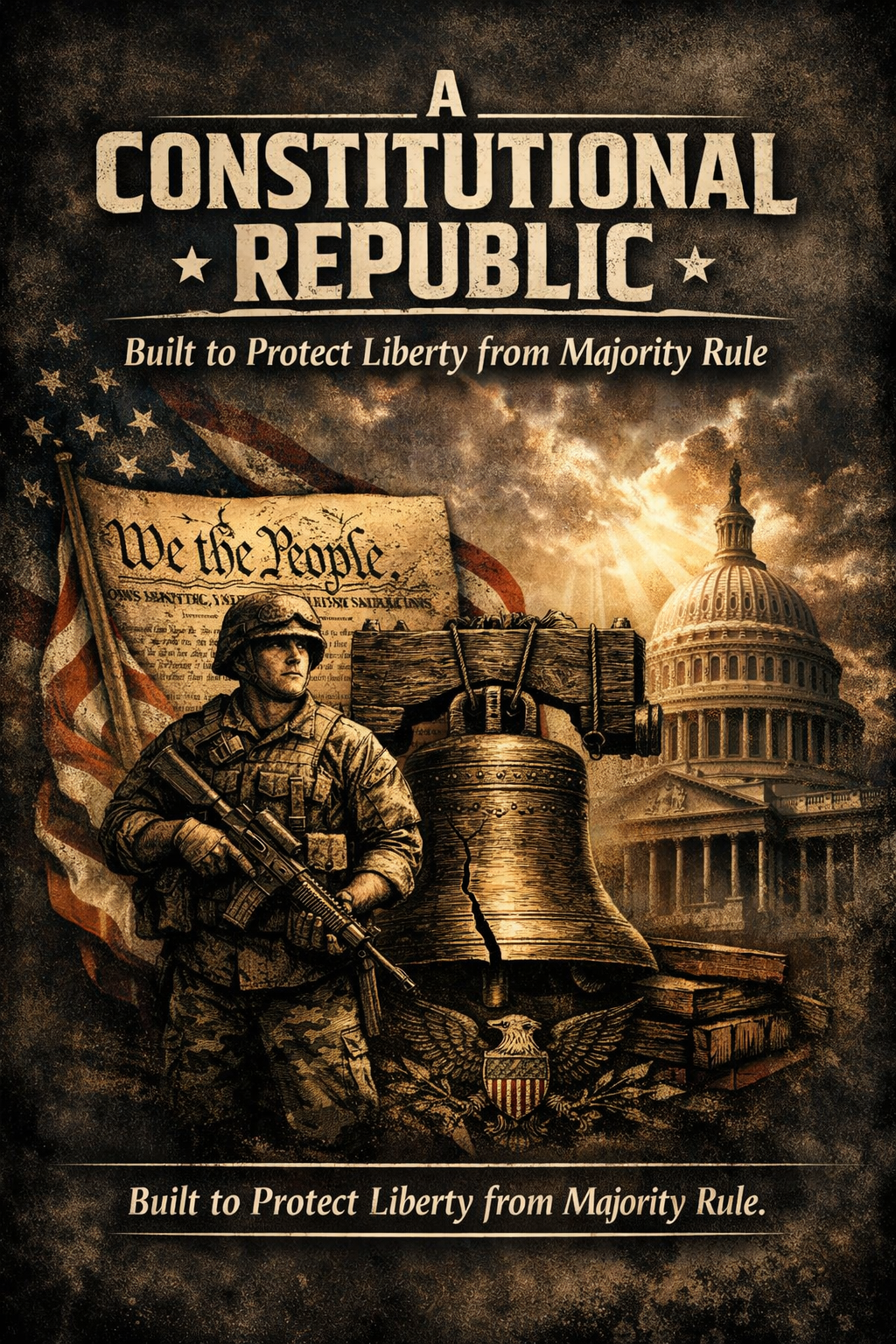
America was not founded as a democracy. It was deliberately built as a constitutional republic, a system crafted to restrain government power, protect personal rights, and prevent the tyranny that inevitably grows from majority rule.
Understanding the difference isn’t academic nitpicking. It’s essential to preserving the freedoms generations of Americans have fought to defend.

Democracy vs. Constitutional Republic: The Core Divide
A democracy centers on unrestricted majority rule. The people vote for leaders, and those leaders—acting as a majority—can pass any law they wish. If 51% want something, that becomes the law of the land. History shows that democracies tend to drift toward centralized authority, promising equality and security while delivering poverty and control.
A constitutional republic operates differently. While citizens still elect representatives, those representatives are bound by a Constitution that limits what they can do. They cannot pass laws simply because a majority demands it. Their authority is restricted to the powers enumerated in the founding charter.
The ideal of democracy is universal equality. The ideal of a constitutional republic is individual liberty.
One seeks to make everyone the same. The other seeks to ensure everyone remains free.
The Founders Warned Us About Democracy
The architects of the American system were explicit: democracy was dangerous.
- Edmund Randolph described the Constitutional Convention’s purpose as creating a cure for “the follies and fury of democracy.”
- Elbridge Gerry and Roger Sherman urged the creation of a system that would eliminate the evils produced by excessive democracy.
- Alexander Hamilton warned that pure democracy leads to monarchy.
- John Adams wrote that democracy becomes “revengeful, bloody, and cruel.”
- James Madison, the father of the Constitution, argued that democracies are incompatible with personal security and property rights.
These weren’t offhand remarks. They were the philosophical backbone of the American experiment.
The Founders understood human nature. They knew that majorities can be just as tyrannical as kings. They knew that liberty requires guardrails. And they built those guardrails into the Constitution.
Equality in the Declaration, Liberty in the Constitution
Critics often point to the Declaration of Independence and its famous phrase, “all men are created equal,” as proof that America was intended to be a democracy. But the Declaration’s meaning is clear: equality before God and before the law, not equality of condition, outcome, or material wealth.
The Constitution—written eleven years later—does not establish a democracy. It establishes a republic designed to secure the unalienable rights listed in the Declaration: life, liberty, and the pursuit of happiness.
Government‑mandated equality destroys liberty. Government‑protected liberty allows people to rise, fall, strive, and succeed according to their own abilities and choices.
The Modern Drift Toward Democracy
Over the past century, America has drifted toward democratic thinking. Language has been reshaped. Institutions have been pressured. Courts have cited modern social theories instead of constitutional principles. Politicians increasingly speak of “protecting our democracy” rather than preserving our republic.
This shift isn’t accidental. When people forget the limits placed on government, government expands. When people forget the meaning of liberty, they trade it for promises of safety. When people forget the structure of the republic, they become vulnerable to the very tyranny the Founders feared.
Why It Matters Today
A republic requires vigilance. It requires citizens who understand the system they inherited. It requires people willing to defend constitutional limits even when those limits prevent their preferred policies.
Benjamin Franklin captured the challenge perfectly. When asked what form of government the Convention had created, he replied:
“A republic—if you can keep it.”
Keeping it means remembering what it is. Keeping it means resisting the seductive simplicity of majority rule. Keeping it means educating others so the principles of liberty do not fade into political slogans.
The Responsibility Falls on Us
The American constitutional system is unique in history. It transformed a wilderness into a powerhouse of innovation, prosperity, and freedom. It protected citizens from both government tyranny and reckless mob rule.
But it only works if the people understand it.
The task now is simple and difficult at the same time: educate, clarify, and defend. Share the truth about the republic. Challenge the misuse of the word “democracy.” Remind others that liberty—not equality—is the foundation of American freedom.
A republic is not self‑sustaining. It survives only when its citizens choose to keep it.






Leave a Reply