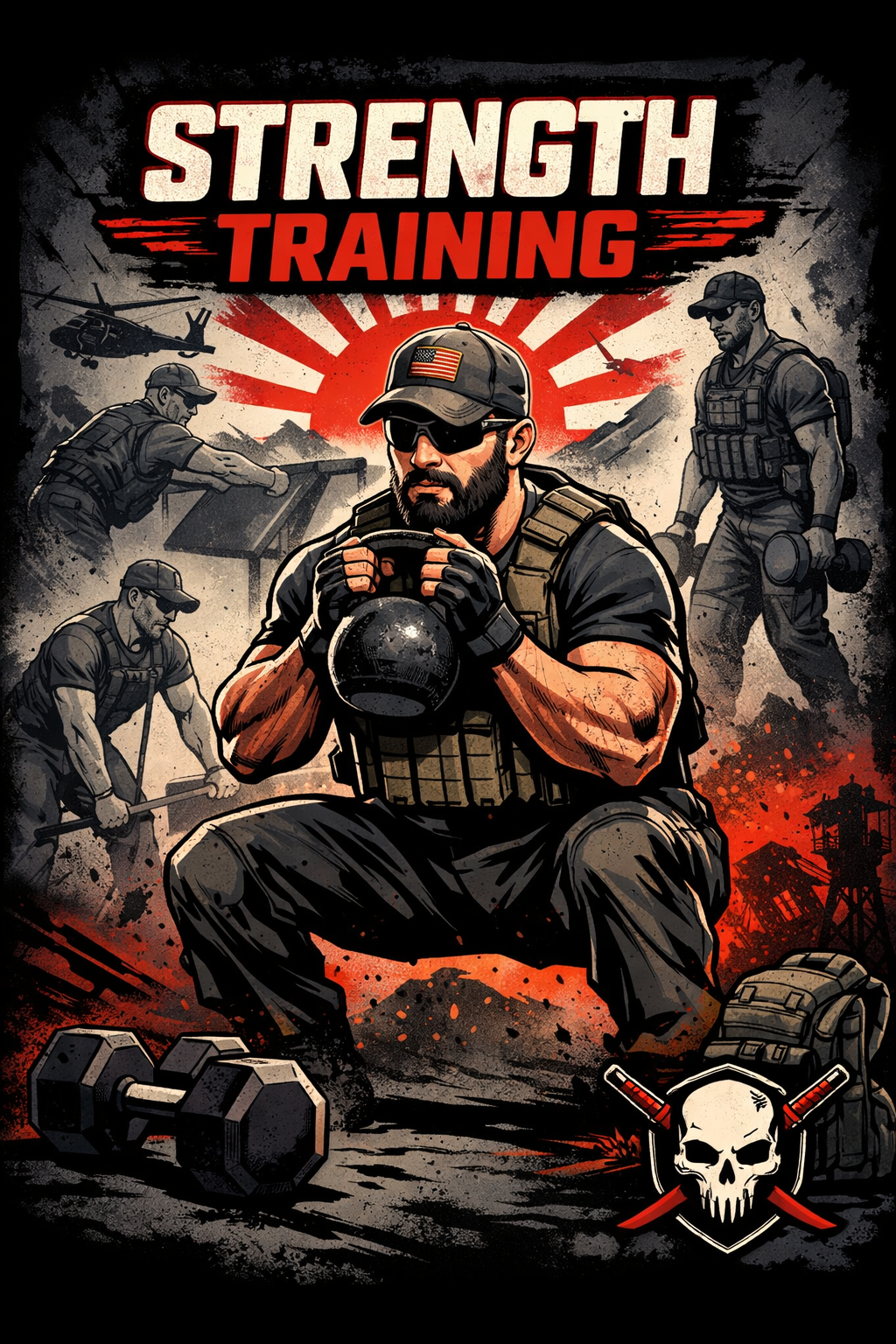
A weekly fitness series for veterans restoring strength, stability, and confidence
Why Strength Training Matters for Veterans
Veterans often experience:
- Weak posterior chain from years of load-bearing
- Shoulder instability from gear and repetitive strain
- Knee pain from rucking and impact
- Lower‑back tightness from uneven terrain and heavy loads
- Reduced strength after long periods of inactivity
This workout uses controlled, functional strength movements that build real‑world capability.

Warm-Up (5 Minutes)
- Arm Circles — 30 seconds each direction
- Hip Hinge Practice (hands on thighs) — 1 minute
- Glute Bridge Hold — 30 seconds
- March in Place — 1 minute
- Band Pull-Aparts — 1 minute
Main Workout (25 Minutes)
A balanced strength session targeting legs, core, and upper body with veteran‑friendly modifications.
1. Goblet Squat (Dumbbell or Kettlebell)
Reps: 3 sets of 8–12 Why it helps: Builds leg strength while keeping torso upright to reduce back strain. Modification:
- Use a chair for box squats
- Reduce depth if knees are sensitive
2. Standing Row (Band or Cable)
Reps: 3 sets of 10–15 Why it helps: Strengthens upper back and improves posture — critical for shoulder health. Modification:
- Use lighter resistance
- Perform seated if balance is limited
3. Hip Hinge Deadlift (Light Dumbbells)
Reps: 3 sets of 8–10 Why it helps: Rebuilds posterior chain strength without heavy loading. Modification:
- Use a backpack instead of weights
- Reduce range of motion if back is tight
4. Push-Up Variation (Incline or Standard)
Reps: 3 sets of 6–12 Why it helps: Strengthens chest, shoulders, and triceps with scalable difficulty. Modification:
- Wall push-ups for shoulder pain
- Countertop push-ups for reduced load
5. Loaded Carry (Farmer or Suitcase Carry)
Time: 30–45 seconds × 3 rounds Why it helps: Builds grip, core stability, and real‑world strength. Modification:
- Use one weight for suitcase carry
- Use water jugs if dumbbells aren’t available
Cool Down (5 Minutes)
- Hamstring Stretch — 30 seconds per side
- Chest Doorway Stretch — 30 seconds
- Child’s Pose — 1 minute
- Deep Breathing — 1 minute

Progression Chart
| Week | Squat Reps | Row Reps | Deadlift Load | Notes |
|---|---|---|---|---|
| 1 | 8–12 | 10–15 | Light | Focus on form |
| 2 | 10–14 | 12–18 | Light–Medium | Add tempo (3 sec down) |
| 3 | 12–15 | 15–20 | Medium | Add 1 extra set |
| 4 | 15–20 | 18–22 | Medium–Heavy | Increase carry time |
Adaptive Options for Common Veteran Injuries
Knee Pain
- Use box squats
- Reduce squat depth
- Replace deadlifts with glute bridges
Lower Back Pain
- Keep deadlifts light
- Prioritize hip hinge practice
- Add extra core stability work (dead bugs, bird dogs)
Shoulder Limitations
- Use wall push-ups
- Keep rows light and controlled
- Avoid overhead movements entirely
Verified Resource Links
- VA Whole Health – Moving the Body Guidance on safe movement, strength training, and pain‑free exercise. https://www.va.gov/WHOLEHEALTH/circle-of-health/moving-body.asp
- VA Adaptive Sports & Events National programs supporting adaptive fitness and rehabilitation. https://department.va.gov/veteran-sports/
- Team Red, White & Blue (Team RWB) Veteran fitness community with local strength and conditioning events. https://www.teamrwb.org/
- Adaptive Training Academy (ATA) Veteran‑founded organization specializing in adaptive and inclusive strength training. https://www.ata.fit/





Leave a Reply