Situational Awareness – OSINT and Awareness
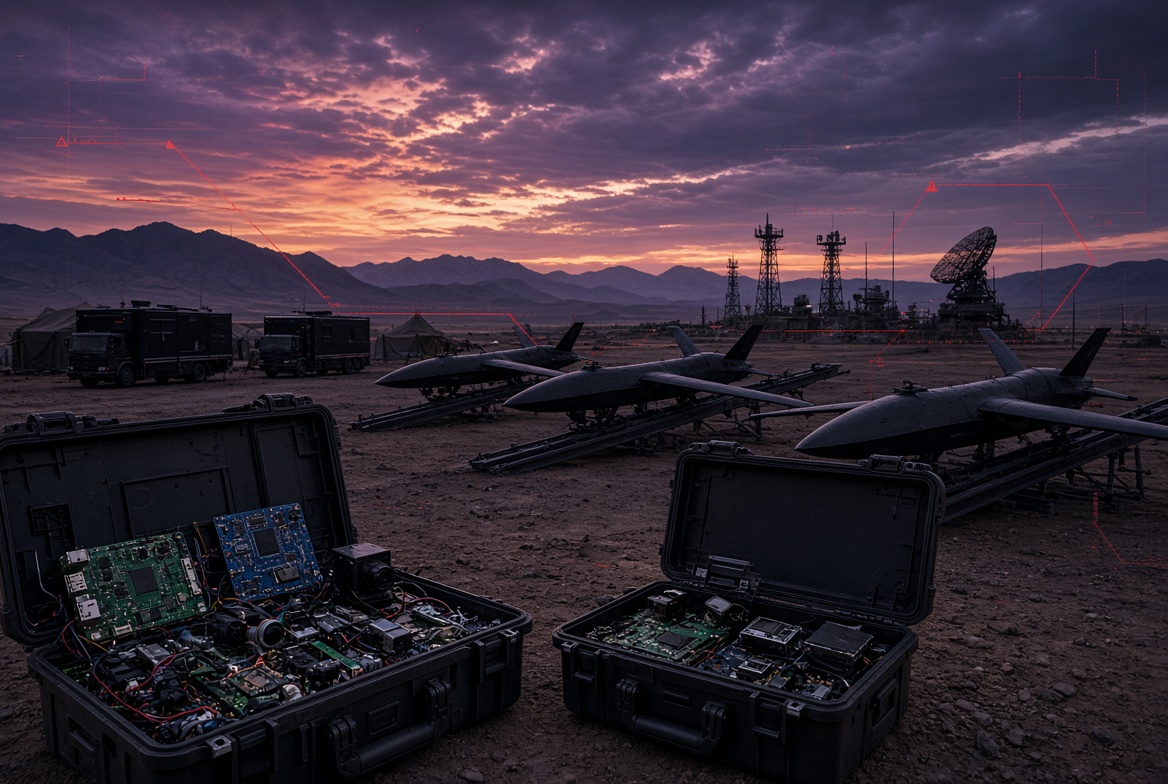
In recent years the U.S. military has moved aggressively to close the gap between battlefield need and industrial capacity. Stockpiles of key munitions have been drawn down sharply. Complex, high-end systems that once took years to field are now viewed as too slow and too expensive for the volume of threats facing the force. In response, two parallel efforts have taken shape: the Army is opening its test ranges to private companies with minimal preexisting government relationships, and major contractors are designing guidance systems and other components around commercial parts that can be produced faster and at far lower cost.
These steps are presented as pragmatic adaptations to a new reality. A company with a promising drone, counter-drone system, or interceptor no longer needs an established program of record or a battery of lawyers simply to prove its equipment works under realistic conditions. Ranges previously reserved for government-led testing are being made available through a single online portal. Contested electromagnetic environments modeled on recent combat experience, long-range fires corridors, and open-air drone ranges are being offered so industry can iterate quickly. At the same time, seekers and other high-cost elements of guided weapons are being redesigned around modular, open-architecture commercial components so the same sensor can be reused across interceptors, bombs, and cruise missiles. The explicit goal is to put guidance on more weapons for less money and to field those weapons before inventories reach critically low levels.
The logic is straightforward. Traditional acquisition timelines and proprietary military-specification components cannot keep pace with the rate at which adversaries are producing cheap, numerous threats. Opening ranges removes friction. Commercial parts reduce unit cost and enable higher production rates. Officials argue that a company no longer has to wait for a formal partnership to demonstrate performance in contested airspace or degraded-signal conditions. Reusable, modular seekers can be adapted across product lines without redesigning the entire weapon. Early testing of one such ultra-low-cost radar seeker has shown it can detect and track targets under a variety of conditions, survive acceleration and vibration, and operate in any weather against moving targets. The promise is more guided munitions in inventory and faster learning cycles for industry.
Yet the very features that make these approaches attractive also introduce risks that have received less public attention. Granting private firms access to military test ranges, even those without ongoing contracts, expands the circle of organizations that can observe sensitive range capabilities, electronic-warfare environments, and test methodologies. While the stated intent is to accelerate development, the practical effect is to lower the barrier for companies whose primary incentives are commercial rather than strategic. Data generated on those ranges, even if carefully controlled, becomes part of a broader industrial knowledge base that can be harder to compartmentalize. Foreign ownership, dual-use technologies, and supply-chain relationships that are routine in commercial markets take on different weight when the same companies are testing systems destined for critical defense roles.
The shift toward commercial off-the-shelf components carries its own set of concerns. Seekers have historically been among the most expensive and carefully engineered elements of guided weapons precisely because failure in the terminal phase can render an entire interceptor useless. Designing them around adapted commercial parts prioritizes affordability and modularity. That choice may be appropriate for lower-tier threats, but it leaves open questions about performance against sophisticated electronic attack, extreme environmental conditions, or the kind of high-end threats that high-cost military-specification seekers were built to defeat. Reliability over years of storage, resistance to countermeasures, and consistency across large production lots are harder to guarantee when the underlying components were never designed for military life-cycle requirements.
There is also the matter of long-term industrial base health. When the military relies more heavily on commercial supply chains for critical guidance and sensor technology, it inherits the vulnerabilities of those chains: single-source dependencies, geopolitical chokepoints, and the possibility that a commercial product line is discontinued or redesigned without regard for defense needs. Modularity and open standards are presented as solutions because they allow parts to be swapped later. In practice, they can also create a permanent state of incremental change that makes configuration control, cybersecurity hardening, and fleet-wide upgrades more complex. The same flexibility that speeds initial fielding can complicate the disciplined sustainment that keeps systems operational over decades.
The broader cultural shift is equally consequential. Traditional programs of record, for all their bureaucracy, imposed layers of independent testing, safety certification, and threat-informed requirements. Opening ranges and embracing commercial components short-circuits some of that process in the name of speed. The result can be faster prototypes and more units in inventory, but it can also compress the time available for discovering failure modes that only appear under the full stress of combat conditions or extended operational use. When stockpiles of high-end interceptors have already been heavily drawn down, the temptation to accept “good enough” solutions that can be produced in volume is understandable. The risk is that volume is purchased at the expense of the margin of performance that has historically separated U.S. systems from those of potential adversaries.
None of this means that greater industry access or the selective use of commercial technology is inherently unwise. Modern conflict demands scale, and scale requires cost discipline and rapid iteration. The problem lies in the balance. Treating private-sector access to military ranges as a routine administrative convenience, and treating commercial components as a default path to affordability, shifts the burden of proof. Instead of industry having to demonstrate that commercial solutions meet military standards, the military increasingly has to prove that traditional standards are still necessary. That inversion deserves careful scrutiny.
The pressure to produce more weapons faster is real. Depleted inventories and the demonstrated ability of adversaries to field large numbers of relatively inexpensive threats make delay itself a risk. Yet the systems that protect American forces and project power have never been optimized solely for speed or unit cost. They have been optimized for the unforgiving requirement that they work when everything else has failed. Opening the gates of test ranges and redesigning critical components around commercial parts may deliver short-term gains in production rate and unit price. Whether those gains come with acceptable trade-offs in security, reliability, and strategic autonomy is a question that has not yet been answered with the same urgency that has driven the policy changes themselves.




Leave a Reply